
 Authorized Sunpak dealer
One Heater. The Real Decision Is How You Switch It.
Sunpak builds one 48 inch gas infrared heater in two outputs and four control packages. Black or stainless is the easy part. This page settles the rest, and lands you on the exact part number.
Black or stainless, natural gas or propane. On propane the S25 mounts horizontal only.
Tilts to 30 degrees on either fuel, so the heat can be aimed at the seating.
Ships with a handheld remote and a wireless wall control. No control wiring to run.
Runs from a hardwired lighted Hi/Lo switch, part 12052. AEI points commercial installs here.
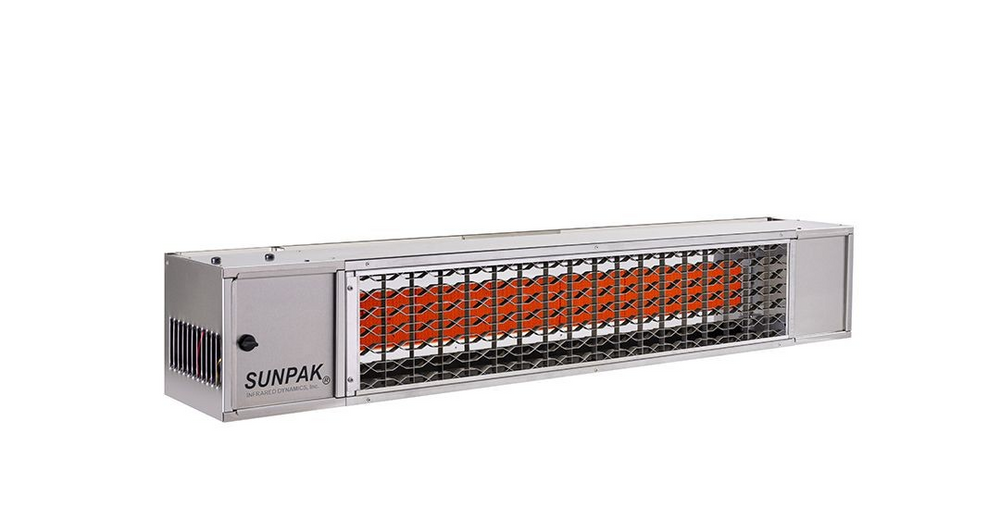
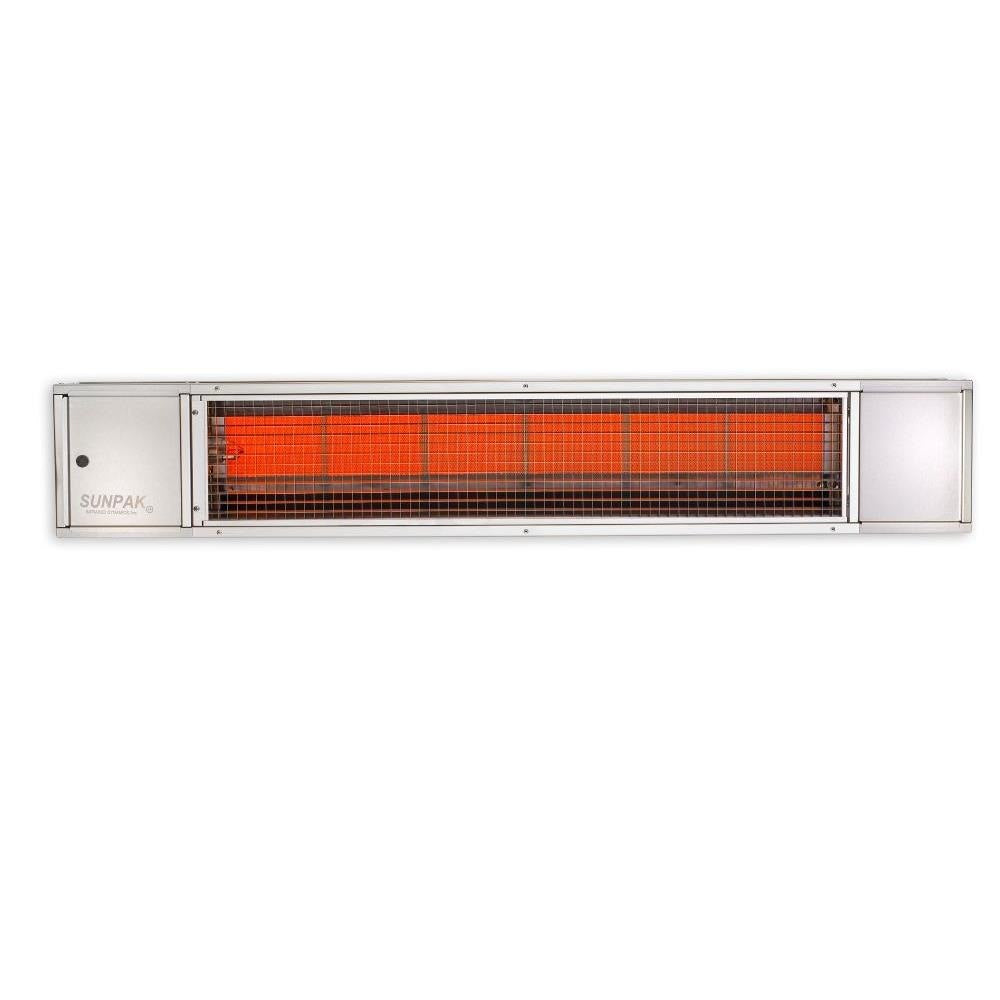
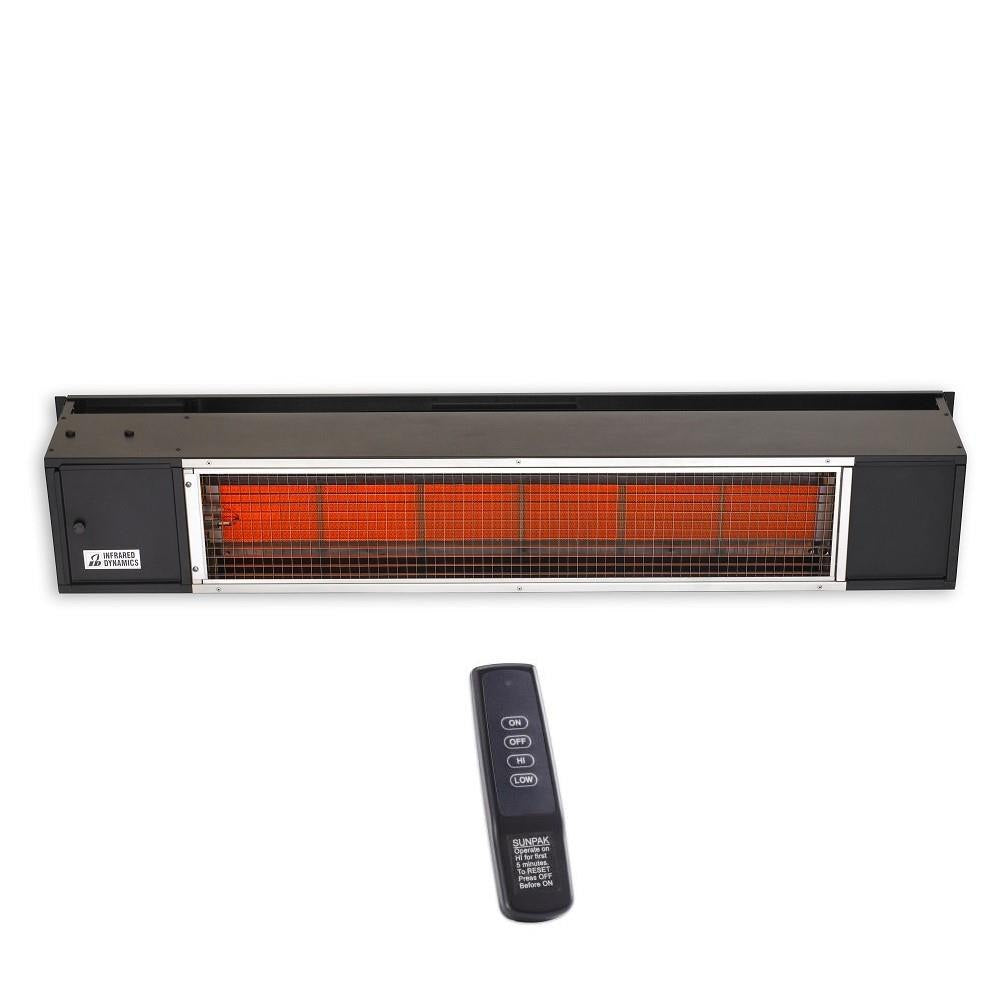
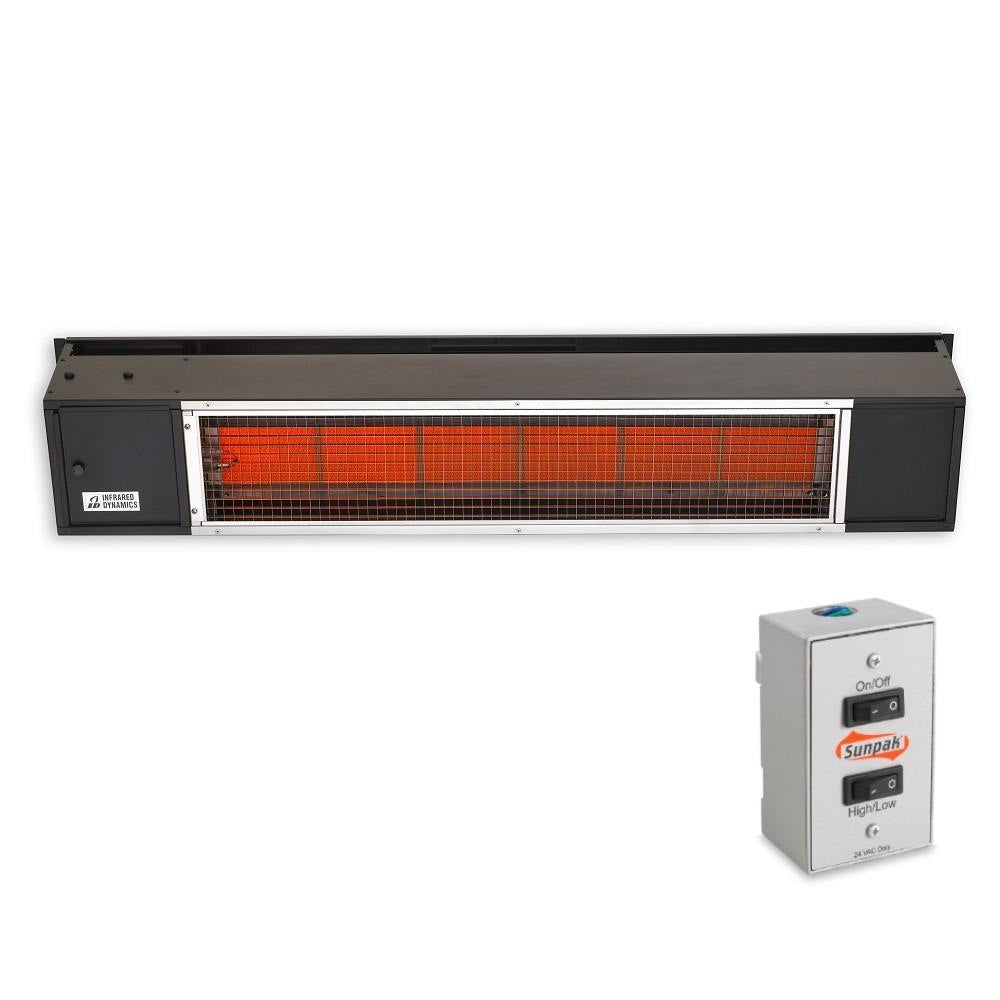
- 4Heater models
- 25,000 to 34,000BTU per hour
- CSAInternational certified
- 48 inOne length, every model
All Four, Side By Side.
Same 48 inch body, same clearance table above 25,000 BTU, same finishes. What changes is the output and the thing on the wall that turns it on.
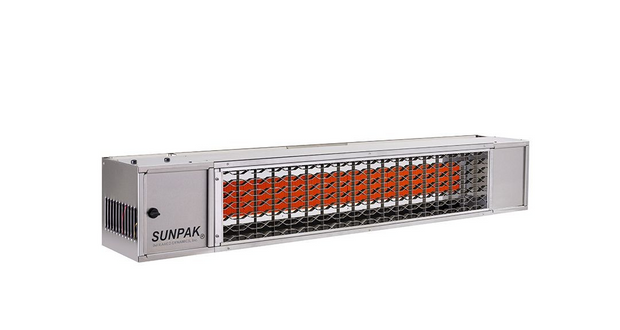
Sunpak S25
- Output
- 25,000 BTU/hr
- Stages
- One, on or off
- Switched by
- A wall switch on 24 VAC
- Coverage
- Approx 10 x 10 ft
- Tilt
- 0 to 30 degrees, natural gas only
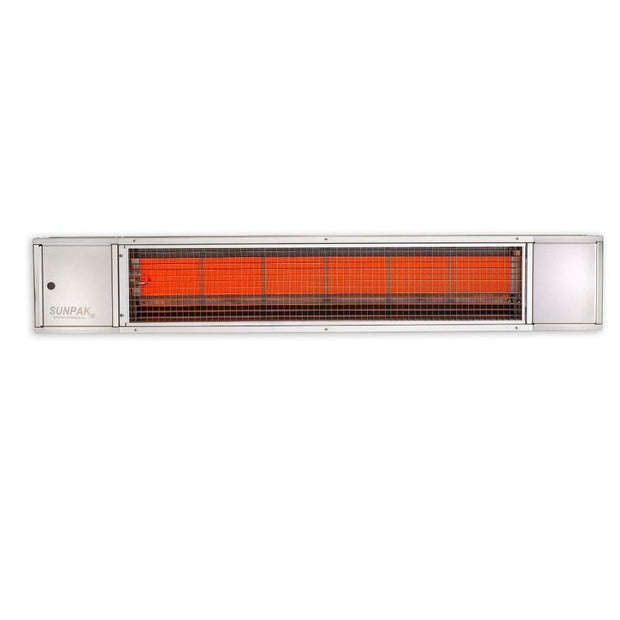
Sunpak S34
- Output
- 34,000 BTU/hr
- Stages
- One, on or off
- Switched by
- A wall switch on 24 VAC
- Coverage
- Approx 12 x 12 ft
- Tilt
- 0 to 30 degrees, either fuel
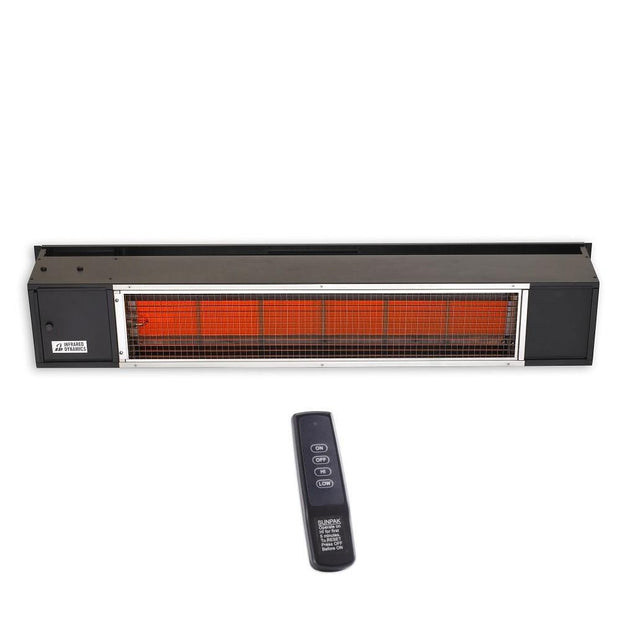
Sunpak S34-TSR
- Output
- 25,000 or 34,000 BTU/hr
- Stages
- Two, Hi and Lo
- Switched by
- Wireless remote and wall control
- Coverage
- Approx 12 x 12 ft
- Power
- 7.5 VDC adapter, included
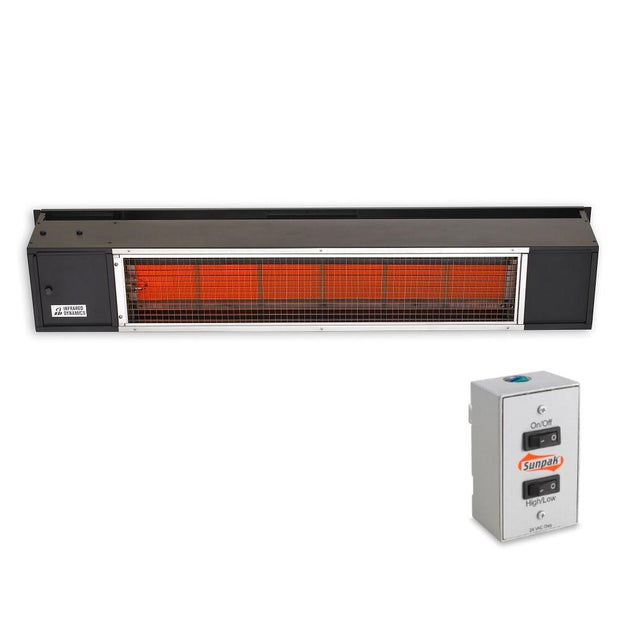
Sunpak S34-TSH
- Output
- 25,000 or 34,000 BTU/hr
- Stages
- Two, Hi and Lo
- Switched by
- Hardwired Hi/Lo switch, part 12052
- Coverage
- Approx 12 x 12 ft on high
- Power
- 24 VAC, 20 VA per heater
Find The Exact Part Number.
One question at a time, and it ends on the exact part number.
Coverage footprints are AEI's own figures, and AEI labels them approximate.
Everything Sunpak We Stock
Four heaters, two fascia kits and the wireless wall timer. That is the whole Sunpak line, and it all ships from stock.
 View
View
S34 TSH Two Stage Hardwired Gas Infrared Patio Heater, 48", 25,000 and 34,000 BTU
 View
View
Wireless Wall Timer, 30/60/120
 View
View
S34 TSR Two Stage Gas Infrared Patio Heater, 48", 25,000 and 34,000 BTU
 View
View
Front Fascia Kit, Black
 View
View
Front Fascia Kit, Stainless Steel
 View
View
S34 Gas Infrared Patio Heater, 48", 34,000 BTU
 View
View
S25 Gas Infrared Patio Heater, 48", 25,000 BTU
It Warms People And Surfaces, Not The Air.
Heated air drifts off on the first breeze, which is why a patio can feel cold with a heater running in it. Infrared crosses the space and lands on people, chairs and stone, so the warmth is where you are sitting rather than somewhere above your head. Sunpak plumbs into the gas line you already have and asks for a low voltage switch, and then it is part of the building.
What The Install Involves.
AEI puts it plainly: this is not a project for the weekend do it yourself person, and they recommend a licensed, bonded HVAC contractor. Here is what that contractor will ask for, so nothing stalls once the heater is on site.
The gas line
A half inch minimum inlet pipe, a drip leg or sediment trap in the supply to each heater, and a lever handled shutoff valve within six feet of it for service. Sunpak publishes no pipe sizing chart, so the run length is a fuel gas code question for your gas fitter.
- 1/2 inMinimum inlet pipe
- 6 ftShutoff valve within
- 6 and 11 in W.C.Minimum inlet, gas and propane
The low voltage side
The S25, S34 and TSH run on a 24 VAC Class 2 transformer, which is never mounted inside the heater. One 40 VA transformer will carry two heaters. The TSR skips all of this and runs from its own included adapter into an ordinary outlet.
- 24 VACClass 2 control circuit
- 20 VAPer heater, minimum
- 18 GAWire up to 50 feet
Where it is allowed to go
Outdoors, by Sunpak's definition: walls on all sides with no cover, or a cover with no more than two walls, or a cover and three walls as long as 30 percent of the perimeter stays permanently open. It is unvented, so it needs air, and it never goes into a soffit or a ceiling recess.
- 30%Perimeter open, if three walls
- 4 cfmAir per 1,000 BTU
- NeverRecessed or enclosed
Hanging it
One kit, part 12006, covers wall, ceiling and fascia board mounting at horizontal or at the 30 degree tilt. The heater weighs about 41 pounds and the supports have to be rated well above that. Level lengthwise, and never vertical.
- 75 lbMinimum support load
- 12006Sunpak mounting kit
- 0 to 30Degrees of tilt
None of this is a reason not to do it. It is the reason to have the gas and the low voltage run before the heater lands, so the install is one visit instead of three. Send us the layout and we will put these figures in writing for whoever is doing the work.
Talk it through with us first Authorized dealer
Ordered On The Part Number, Not A Description.
Aqua Terra Backyard is an authorized Sunpak dealer. Every heater on this page is ordered against AEI's own part number, so the SKU on your invoice is the SKU that arrives, in the finish and the fuel you picked.
Genuine, on the part number
Every heater here is ordered against AEI's published part number, 12001 through 12042. You are not buying a description of a heater, you are buying a SKU.
We will tell you when it is the wrong one
Propane and a tilted mount do not go together on an S25, and AEI's own coverage figures shrink in a cold climate. We would rather say so now than ship you the heater you asked for and watch it come back.
The clearance table, before you drill
Tell us the wall, the cover height and the fuel and we will send the published clearances and the typical mounting height in writing, ready to hand to your contractor.
Handled from order to driveway
A Sunpak is a 41 pound boxed heater and it travels on a carrier, not in a van. We book it, we track it and we chase it, and you hear from us if anything moves.
Mount It Right The First Time.
A Sunpak is not a heater you wheel out. It goes on a wall or a ceiling and it stays there for twenty years, so the geometry is the part worth getting right. This is drawn to scale from Sunpak's own clearance tables.
All three 34,000 BTU models share one clearance table, so the S34, the TSR and the TSH draw identically.
Sunpak publishes a clearance table at horizontal and at the 30 degree maximum, and nothing in between, so those are the two cases drawn. Clearances are minimums to combustible material, set at a surface temperature 90 degrees Fahrenheit above room temperature. AEI notes that glass, painted surfaces and vinyl siding may need more room still.
Three Things Worth Sorting Out First
Get the gas run before the heater lands
The gas side is the long pole, not the heater. Sunpak wants a half inch minimum inlet pipe, a drip leg or sediment trap feeding each heater, and a lever handled shutoff within six feet for service. Inlet pressure has to reach 6 inches W.C. on natural gas or 11 inches W.C. on propane at the heater.
Sunpak publishes no pipe capacity chart, so how far that half inch will actually carry is a fuel gas code calculation for your gas fitter, not a number we or Sunpak can hand you.
The transformer is the part people forget
The S25, S34 and TSH do not plug in. They need a 24 VAC Class 2 transformer, rated at least 20 VA for each heater, wired to the switch on the wall. A single 40 VA unit will run two heaters, and the transformer must never sit inside the heater itself. Use 18 gauge wire up to 50 feet and 16 gauge beyond that.
The TSR is the exception: it comes with a 7.5 VDC adapter that goes into an ordinary outlet, which is exactly why it suits a patio with no control wiring in it.
Ask us what is in your box
This one is a genuine disagreement in Sunpak's own paperwork and we would rather you heard it from us. AEI's current product pages list the mounting kit and the 24 volt transformer as included. The Infrared Dynamics manuals call the 12006 mounting kit optional, and the TSR and TSH manuals say it is included in some packages.
Contents vary by SKU, so before your order ships we will confirm with AEI exactly what comes in the carton for your part number and tell you what else to add.
Questions We Get Asked
Where AEI and the Infrared Dynamics manuals disagree, the answer says so instead of picking the flattering number.
What is the difference between the S34-TSR and the S34-TSH?
Only the control. Both are the same two stage 34,000 BTU heater, running 25,000 BTU on low and 34,000 on high. The TSR is wireless: a handheld remote and a wireless wall control ship with it, and it powers from an included 7.5 VDC adapter into an ordinary outlet, so there is no control wiring to run. The TSH is hardwired to a lighted Hi/Lo switch on the wall, part 12052, on a 24 VAC circuit, with no remote to lose and no batteries to replace. AEI points commercial installations at the TSH for that reason.
How much area does one Sunpak heat?
AEI publishes an approximate 10 by 10 foot footprint for the 25,000 BTU S25 and an approximate 12 by 12 foot footprint for the 34,000 BTU models, and labels both approximate. In a cold or windy climate AEI revises those down to roughly 10 by 10 feet for an S34 and 8 by 8 feet for an S25. Where more than one heater is needed, the spec sheet gives 10 feet as the average spacing between them. Sunpak publishes no square footage rating and no BTU per square foot rule, so treat any such figure you see elsewhere as somebody else's arithmetic.
How high should a Sunpak be mounted?
There is no published minimum, only a typical range and a warning to check your local code. The installation manual states that some local codes require every part of an overhead radiant heater to sit at least 8 feet above the floor. AEI's spec tables give 7 feet 6 inches to 9 feet 6 inches as typical for the S25, and 8 to 9 feet horizontal or 7 to 8 feet at a 30 degree tilt for the S34, TSR and TSH. AEI's own FAQ separately suggests 9 feet 6 inches to 12 feet for the S34, which does not agree with its tables, so we use the tables and let the clearance figures and your local code set the real limit.
What clearances to combustibles does it need?
It depends on the model and the angle, and Sunpak publishes one table for each. Mounted horizontally, the S25 needs 12 inches behind, 9 inches above, 24 inches at the gas inlet end and 48 inches clear below the mounting. The S34, TSR and TSH share a second set: 17 inches behind, 13 inches above, 24 inches at the inlet end and 48 inches below. Tilted to the 30 degree maximum, the rear clearance on both drops to 8 inches while the ceiling clearance rises, to 14 inches on the S25 and 18 inches on the 34,000 BTU models. These are minimums to combustible material, set at a surface temperature 90 degrees Fahrenheit above room temperature, and AEI notes that glass, painted surfaces and vinyl siding may need more room still. The casing finish makes no difference: Sunpak publishes the same table for stainless steel and black.
Can it go under a covered patio?
Yes, as long as the clearances above are maintained, and it must not be recessed into the ceiling or a soffit. What it cannot do is sit in a fully enclosed space. Sunpak's own definition of outdoors is walls on all sides with no overhead cover, or an overhead cover with no more than two side walls, or an overhead cover and three walls as long as 30 percent of the horizontal periphery is permanently open. The heater is unvented, so it also needs 4 cfm of supply and exhaust air per 1,000 BTU of input.
Can I heat my garage with one?
No. AEI answers this directly: Sunpak heaters are approved for outdoor residential use, and the manual says the heater is not approved for any indoor residential application, an attached garage included. AEI also rules out ice fishing tents, barns, boats, RVs, and any enclosed living space for people or animals.
What does the installation actually involve?
A gas line, a low voltage control circuit and a contractor. On the gas side Sunpak requires a minimum half inch inlet pipe, a drip leg or sediment trap in the supply to each heater, and a half inch lever handled shutoff valve within 6 feet of the appliance, with a minimum inlet pressure of 6 inches W.C. on natural gas or 11 inches W.C. on propane. On the electrical side the S25, S34 and TSH need a 24 VAC Class 2 transformer rated at least 20 VA per heater, and a 40 VA transformer will run two; the TSR uses its own included 7.5 VDC adapter instead. Mounting supports have to carry a working load of at least 75 pounds. AEI is blunt about who should do it: this is not a project for the weekend do it yourself person, and they recommend a licensed, bonded HVAC contractor.
Can it be angled toward the seating?
Up to 30 degrees, and the one exception is worth knowing before you order. Sunpak allows a mounting angle of 0 to 30 degrees or face down, and requires the heater to stay level lengthwise and never be mounted vertically. The S25 on propane is specified for the horizontal position only, so if you want the heat aimed at the seating on propane, the S34 is the one that tilts.
Does wind stop it working?
It changes how much you feel, and there are two published numbers for two different questions. The certified wind rating on the spec sheet is 10 mph horizontal. Separately, AEI says a continual breeze of 20 mph or more will make heating any patio difficult. The manual also warns that severe updrafts, the kind you get on a raised terrace or a rooftop patio, can damage the heater. Sunpak's own advice is to place heaters where the heat loss is greatest, such as the open side of a semi protected patio.
How much warmer will it actually feel?
Sunpak states 5 to 10 degrees Fahrenheit outdoors, and both AEI and the installation manual give the same figure. Because this is infrared, it warms people and surfaces rather than the air, which is why it works at all in an open space where heated air would simply drift away.
About Sunpak
Sunpak builds one gas fired infrared patio heater, 48 inches long and 8 inches square, and then offers it four ways. The S25 puts out 25,000 BTU per hour on a single stage. The S34 puts out 34,000 on a single stage. The S34-TSR and the S34-TSH are the same two stage 34,000 BTU heater, dropping to 25,000 on low, and they differ only in what turns them on: the TSR by wireless remote and wireless wall control, the TSH by a hardwired lighted switch. Every one of them comes in powder coated black or stainless steel, for natural gas or propane. Sunpak is a brand of AEI Corporation, which also owns Infratech, Sunglo, SunStar and PGS Grills.
Which Sunpak is right for my patio?
Work from the control first and the output second. AEI gives an approximate 10 by 10 foot footprint for the 25,000 BTU S25 and an approximate 12 by 12 foot footprint for the 34,000 BTU models, and revises both down in a cold or windy climate to roughly 8 by 8 and 10 by 10. Where more than one heater is needed, the spec sheet gives 10 feet as the average spacing between them. If you want the heat adjustable rather than simply on or off, that points at a two stage heater, and the only question left is whether you would rather hold a remote or press a switch on the wall.
Where is a Sunpak allowed to go?
Outdoors, by Sunpak's own definition: walls on all sides with no overhead cover, or an overhead cover with no more than two side walls, or an overhead cover and three walls as long as 30 percent of the perimeter stays permanently open. A covered patio is fine as long as the published clearances are held. A garage is not, and neither is a ceiling recess or a soffit. The heater is unvented, so it also needs 4 cfm of supply and exhaust air for every 1,000 BTU of input.
What clearances does it need?
Mounted horizontally, the S25 needs 12 inches behind, 9 inches above, 24 inches at the gas inlet end and 48 inches clear below the mounting. The S34, TSR and TSH share a second table: 17 inches behind, 13 inches above, 24 inches at the inlet end and 48 inches below. Tilted to the 30 degree maximum, the rear clearance drops to 8 inches on both while the ceiling clearance rises. The casing finish makes no difference, because Sunpak publishes one table per model regardless of whether it is black or stainless.
Can I install one myself?
AEI's answer is no, and they are blunt about it: this is not a project for the weekend do it yourself person, and they recommend a licensed, bonded HVAC contractor. A Sunpak needs a half inch minimum gas inlet with a drip leg and a shutoff valve within six feet, a 24 volt control circuit on a Class 2 transformer rated at least 20 VA per heater, and mounting supports rated for at least 75 pounds. Send us the layout and we will put the published figures in writing for whoever does the work.